they are coming unblocked
Popular Games
Last Played
If you’re hunting for quick, polished, no-download fun that runs anywhere, poki game is literally the blueprint. Poki’s library is stacked with hyper-responsive web titles that boot in seconds, scale to any device, and actually respect your time (rare!). Whether you’re sneaking in a level at school, grinding a commute on mobile, or chilling on desktop, you’ll find everything from reflex runners to devious puzzle traps to big-mood sandbox chaos—all in the browser, zero installs, zero drama.
And yup, the traffic-tested move is simple: play poki game now on Poki. You’ll get crisp performance, clean UI, and enough variety to keep your dopamine loop fed without the shady pop-ups or sketchy files. Old-school convenience, next-gen delivery. That’s the play.
At its core, a poki game is a browser game—a title that runs directly in your web browser using modern tech (WebGL, WebAssembly, JS/TS, etc.) and needs no installation. That’s the magic: instant access, platform-agnostic, saves your storage, and keeps session lengths snackable. It’s the spiritual successor to the Flash era, but with tighter controls, better visuals, and honest-to-goodness cross-device continuity. In other words: you click, you play, you smile—no launchers, no patch notes, no nonsense.
If you want the formal definition, it lines up with the idea of a browser game as defined by Wikipedia. One link, one concept—done. Everything else here is about actually playing smarter.
Let’s keep it 100: controls make or break a web game. Poki’s curation leans into tight input loops so you can vibe within seconds.
Movement basics:
Arrow keys / WASD for platformers, runners, and racers.
Mouse aim + LMB for shooters and physics puzzlers.
Space / Shift / Ctrl often map to jump, dash, or power-ups.
Session design:
30–180 seconds per attempt is the sweet spot—short runs, quick retries.
Checkpoints in campaign-style games; pure score-chasing in arcade loops.
Difficulty ramps that respect first-time players but still punish sloppy habits (in a fun way).
Modes you’ll see:
Endless runner: survive, bank coins, beat your PB.
Skill platformer: spike bait, troll traps, tight jumps—rage-quits optional.
Puzzle cadence: learn the rule, fold the twist, solve under pressure.
Multiplayer / party: chaotic physics, goofy meta, “one more round” energy.
Pro tip: don’t over-customize at first. Run default settings for five minutes, bank the muscle memory, then tweak sensitivity, key binds, or graphics caps if needed.
You want clean wins? Run this playbook:
Two warmups, one real run. Your first two attempts are recon. On run three, commit.
Micro-focus the screen center. Most hazards enter your peripheral; train your eyes to track center-mass and react outward.
Buffer inputs. Tap jump a hair early in twitch platformers; many engines accept buffered inputs during coyote time.
Read the level grammar. Hazard colors, tile patterns, and spawn timings repeat. Identify the tile/hazard “alphabet” and you’ll stop eating cheap deaths.
Economy discipline. In games with coins/upgrades, prioritize mobility (speed, jump control) before damage. Surviving longer prints more currency anyway.
Tilt control. Missed a PB by 2 points? Take 30 seconds. Hydrate. Heart rate spikes wreck execution.
One setting at a time. If you adjust sensitivity, don’t also remap keys. Isolate variables so improvements are measurable.
Know when to full-send. Some titles reward aggressive lines (tight apexes, greedy coin routes). Learn the path, then ship it.
Instant boot: zero install friction means you’re playing before your brain can procrastinate.
Tight feedback: perfect SFX and micro-animations make each input feel buttery.
Short loops, big highs: 90-second runs deliver constant “almost!” moments—dopamine economics 101.
Mastery ceiling: easy to learn, painfully honest to master. You’ll feel the skill growth.
Social snackability: “Try to beat this score” still slaps in 2025. Clip a run, flex the PB, move on.
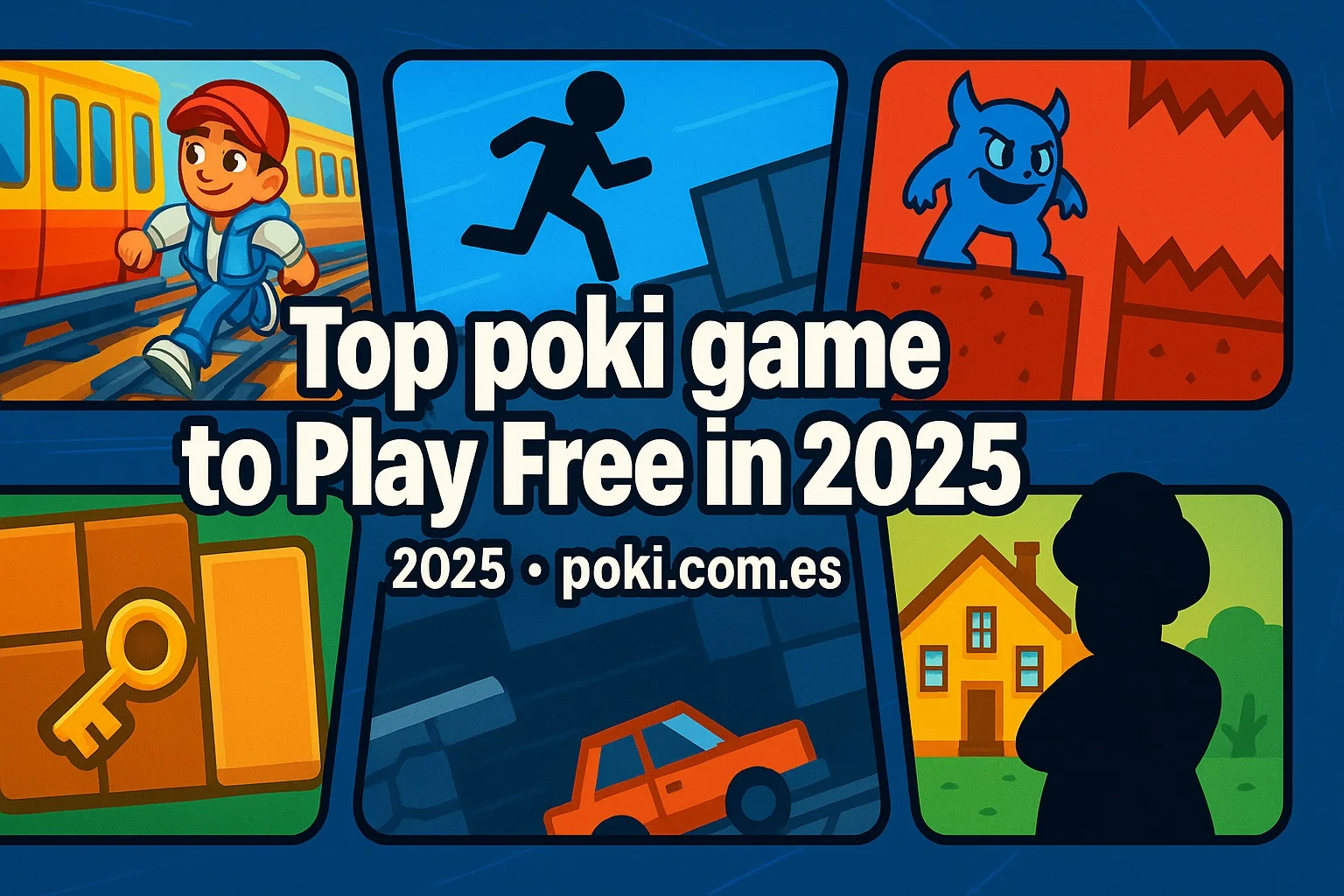
No intro needed—Subway Surfers is the OG endless runner energy drink. You’re dodging trains, threading gaps, and opportunistically snatching power-ups while the Inspector breathes down your neck. What keeps it fresh is line-choice discipline: high-value coin lines versus safe lanes, and whether to burn a hoverboard to armor through a sketchy segment. The upgrade path is classic—boards, characters, magnets—so your “one more run” actually compounds progress. Veteran tip: learn to read upcoming spawns from camera angle shifts; you’ll start pre-positioning for coins and super sneakers like it’s second nature. It’s the perfect poki game vibe: five minutes to warm up, thirty minutes to chase a PB, and an infinite ceiling if you love optimizing routes.
Grav-flip speedrunning at its cleanest. G-Switch 3 reduces your entire control scheme to a single, perfectly timed flip—and then throws gauntlets of saws, gaps, and anti-brain geometry at you. It’s a masterclass in input buffering and rhythm: you’re not just reacting; you’re predicting the map’s cadence. Campaign teaches fundamentals, Endless punishes hesitation, and local multiplayer turns it into a party game with actual depth. Pro move: set a metronome in your head for sections with evenly spaced gaps and treat it like DDR for your thumb. When you hit flow state, you feel unstoppable. Minimalist controls, maximal dopamine.
You think you know platformers—then Level Devil gaslights your expectations for sport. Floors vanish, ceilings collapse, and “obvious” jumps become elaborate pranks. It’s not cheap; it’s pattern subversion as a mechanic. The win condition is mental: scan for telltales (misaligned tiles, suspiciously generous platforms) and assume the map’s trolling you on purpose. The best strategy is slow-fast: creep to trigger the trap, then commit with clean movement through the safe line. Keep your tilt in check; this game will snipe your patience if you let it. Nail a section flawlessly, and the victory is pure endorphin.
Stealth-puzzle hijinks with slapstick payoff. Scary Teacher 3D drops you in a suburban maze of rooms, timers, and mischievous objectives. The joy is in routing: how do you chain tasks through the house without getting caught, and which prank nets the most “worth it” grin? Treat it like micro-stealth: manage line of sight, memorize patrols, abuse audio cues, and always leave yourself an exit path. It’s lighthearted chaos with enough systems to reward smart planning. If you need a palate cleanser between sweaty runners and troll platformers, this is the exact flavor.
Pure puzzle elegance. Free The Key is all about spatial reasoning and move economy—sliding blocks, unlocking pathways, and refusing to brute-force when a clean two-move solution exists. The trick is to think backwards: visualize the final key path and work in reverse, clearing only what’s essential. Track “move parity” (even/odd) on tricky boards to avoid dead-end cycles, and don’t be afraid to reset if your board state looks cursed. It’s the quiet kind of satisfying—the level ends, your brain releases a small firework, and you queue up the next one without even noticing.
Look, there’s a reason Poki still owns the web-gaming lane:
Instant-load infrastructure: CDN-backed delivery + browser-native builds = consistently snappy boot times.
Curated catalog: fewer shovel-ware traps, more titles that respect input latency and feel.
Safe + school-friendly: you get the play button, not the malware roulette.
Device-agnostic: phone, tablet, Chromebook, desktop—if it has a modern browser, you’re in.
Session-savvy design: most games fit a study break, bus ride, or couch cooldown.
Bottom line: play poki game now and let the platform handle the boring parts so you can dial in the fun.
The best poki game experiences nail three things: immediate clarity (you know what to do in 10 seconds), honest physics (inputs feel fair), and a mastery curve that rewards practice. 2025’s lineup checks those boxes across genres. If you’re new, start with Subway Surfers for flow and coin routing. If you want execution training, grind G-Switch 3 or Level Devil. Prefer headspace puzzles? Free The Key will scratch that itch. Need laughs? Scary Teacher 3D is your chaos generator.
Classic browser convenience, modern engine polish—that’s the win. Open a tab, queue a track, and send it.
1) Are poki games free and safe to play at school or work?
Yes—no installs, no accounts required on most titles, and Poki’s pages are cleaner than the average game mirror. If your network blocks games, that’s an IT policy thing, not the site itself.
2) What device runs poki game best—phone, tablet, or PC?
All three work. For twitchy runners and precision platformers, a keyboard on desktop is S-tier. For puzzle and casual titles, touch is totally fine. Try both; pick what fits the game.
3) How do I improve quickly without raging?
Run two recon attempts, then a serious one. Focus on one mechanic per session (jump timing, camera reads, coin lines). If tilt climbs, pause for 30–60 seconds. Performance will bounce back.
4) Do I need to log in to save progress?
Most poki game loops are designed to be session-friendly. Some titles use local storage to remember settings or progress. If a game supports cloud features, it’ll tell you in-page.
5) What should I play first today?