they are coming unblocked
 poki.com.es
Sign in to keep recently played games, favorites and your player profile available on this site.
Popular Games
Last Played
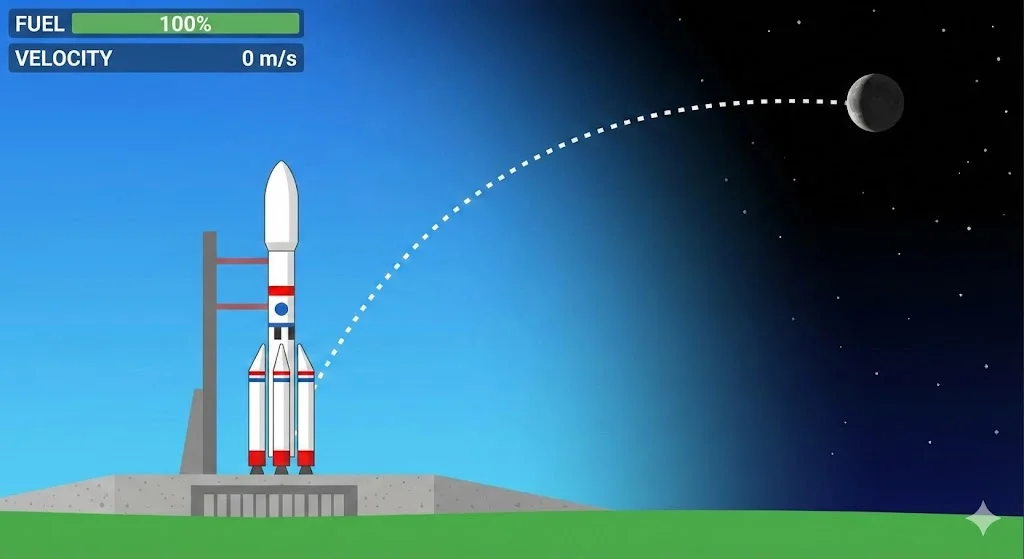
There is a profound curiosity in all of us when we look up at the night sky. We wonder what it takes to actually break free from Earth's gravity and drift among the stars. While most of us will never sit inside a real capsule, the digital world offers a surprisingly accurate alternative. This is where spaceflight simulator online shines. It strips away the intimidating math of aerospace engineering and replaces it with an intuitive, touch-friendly interface that lets you build rockets from scratch. You aren't just a pilot here; you are the chief engineer, the mission controller, and the astronaut all rolled into one.
The genre itself has a rich history. Long before we had browser-based options, enthusiasts relied on complex software that required heavy manuals to understand. The evolution of the space flight simulation game has been about balancing realism with fun. Modern iterations allow you to learn about staging, orbital mechanics, and fuel efficiency through trial and error rather than textbooks. It turns the cold vacuum of space into a personal playground where your only limit is your imagination and the amount of fuel you can strap to your chassis.
When you first load up spaceflight simulator online, you might think it is just a simple building game. However, lurking beneath the simple vector graphics is a robust physics engine that respects the fundamental laws of motion. It teaches you concepts that actual rocket scientists use daily, but it does so organically. You learn quickly that going straight up isn't enough to reach orbit. You have to understand the gravity turn, which is the process of tilting your rocket to build horizontal speed while escaping the atmosphere. If you don't master this, you will just fall back down when the fuel runs out.
The game also forces you to reckon with the tyranny of the rocket equation. Every pound of fuel you add adds weight, which requires more engines, which burn more fuel. It is a delicate balancing act. You start to appreciate why real rockets have multiple stages. Shedding empty fuel tanks to lighten the load isn't just a cool visual effect; it is a necessity for reaching the Moon or Mars.
Aerodynamics plays a role too, albeit a simplified one. You can feel the drag when your rocket is too wide or un-aerodynamic in the lower atmosphere. Pushing through the thick air requires raw power, but once you are in the vacuum, everything changes. The science here is unforgiving but fair. When you fail, you usually know exactly why. Maybe you didn't have enough thrust-to-weight ratio at launch, or perhaps you deployed your parachute too late on reentry. This adherence to Newtonian physics makes every successful mission feel like a genuine intellectual victory rather than just a gaming achievement.
Defining spaceflight simulator online is interesting because it sits somewhere between a game and an educational tool. At its core, it is a sandbox simulation. There are no enemies to shoot, no high scores to beat in the traditional sense, and no timer counting down to zero. Instead, you are given a set of parts—engines, fuel tanks, capsules, struts, fairings—and a blank blueprint. Your goal is whatever you decide it should be. Do you want to put a satellite into a stable low-earth orbit? Do you want to land a rover on the Moon? Or do you just want to see how many engines you can ignite before the whole thing explodes?
You should care because it respects your intelligence. It doesn't hold your hand with endless tutorials. It hands you the keys to the physics engine and says "figure it out." This fosters a sense of agency that is rare in modern gaming. It appeals to the tinkerer in all of us. You might spend twenty minutes perfectly designing a multi-stage rocket, only to realize on the launchpad that you forgot to add a separator between the booster and the capsule.
Furthermore, it is a "persistent" experience in a way. You can leave debris in orbit. If you launch a station and leave it there, it stays there. You can then launch a second rocket to dock with it. This capability to build your own infrastructure in space transforms it from a simple arcade flyer into a complex logistical puzzle. It captures the essence of space exploration: it is hard, it is risky, and it is incredibly rewarding when it works.
The functionality of spaceflight simulator online is surprisingly deep for a browser-based title. The primary function is, of course, the Vehicle Assembly Building. Here, you have access to a grid where you snap parts together. The snapping system is magnetic and intuitive, allowing you to stack fuel tanks or cluster engines without fighting the UI. You can resize parts, change their textures, and organize complex staging sequences to ensure your boosters detach at the exact right moment.
Once you leave the assembly stage, the function shifts to flight control. The interface gives you granular control over your throttle. You can burn at 100% for liftoff and then throttle down to conserve fuel or to perform a delicate landing maneuver. The game also provides a map view, which is essential for navigation. In this view, you see your trajectory lines, your apoapsis (highest point), and periapsis (lowest point). Manipulating these lines by burning your engines at specific points is how you navigate the solar system.
Beyond just flying, the game functions as a creative outlet. Players have used the basic parts to build recreations of the ISS, the Apollo Saturn V, and even sci-fi ships that defy logic. The "Time Warp" function is another critical tool. Space travel takes a long time, so the ability to speed up time allows you to fast-forward through the boring coasting phases of a flight and jump straight to the orbital insertion or landing burns. It essentially compresses the timeline of a real space mission into a digestible lunch-break session.
Controlling your craft in spaceflight simulator online requires a mix of steady hands and strategic planning. On a PC browser, the controls usually map to the keyboard and mouse. You use keys to increase and decrease throttle, and others to rotate your craft left or right. The spacebar is often the "stage" button, which separates used parts. The most critical strategy here is fuel management. Beginners often fly at full throttle all the time, but this is inefficient. In the lower atmosphere, you want to limit your speed to avoid fighting too much air resistance.
Another essential strategy is the "gravity turn" mentioned earlier. A good rule of thumb is to start tilting your rocket slightly once you pass a certain altitude or velocity. If you go straight up until you hit space, you will have zero horizontal velocity, and you won't stay in orbit. You need to be moving sideways very fast (thousands of meters per second) to miss the Earth as you fall. Learning to read the orbit lines on the map is more important than watching your rocket visually.
Landing is the hardest part to master. Whether you are returning to Earth or touching down on the Moon, you need to manage your descent velocity. On Earth, you can rely on parachutes, but you must deploy them at the right height and speed or they will rip off. On airless bodies like the Moon, you have to perform a "suicide burn"—firing your engines at the last possible second to cancel out your speed just before you touch the ground. This requires practicing your timing and knowing exactly how much thrust your engine can output relative to your current weight.
Accessing spaceflight simulator online is generally straightforward since it utilizes HTML5 or WebGL technology, making it compatible with almost any modern web browser. You do not need a high-end gaming PC with a dedicated graphics card. A standard laptop or even a Chromebook is usually sufficient to handle the physics calculations. The "unblocked" aspect is particularly relevant for students or office workers. Many institutions block gaming storefronts like Steam, but browser games often slip through the cracks because they run on standard web ports.
To play, you simply navigate to the hosting site. There are no large files to download and install, which means you leave no footprint on the computer's hard drive. This "click and play" nature is perfect for quick sessions. If you do encounter a firewall, some players use legitimate workarounds like using a mobile hotspot to connect their device to the internet, bypassing the local network's restrictions entirely.
However, keep in mind that since it is a browser game, your save data is often stored in your browser's local cache. If you clear your history or cookies, you might lose your blueprints or progress. It is often wise to export your favorite rocket designs if the game allows it, or simply keep the tab open if you plan to return to it shortly. The accessibility is the main draw; you can start a mission on one computer and, provided you have your save data or just want to start fresh, pick up the hobby anywhere else instantly.
Why do we keep coming back to spaceflight simulator online? It isn't for the graphics, which are charmingly simple, but for the satisfaction of competence. There is a very specific dopamine hit you get when you execute a perfect orbital rendezvous. It is the feeling of having solved a complex problem using your own wits. The game doesn't cheat for you. When you land that rover on Mars after a thirty-minute journey, you know you earned it.
The pacing is also a huge factor. It can be as relaxing or as intense as you want it to be. You can spend an hour just designing a massive space station in the builder, listening to music, with zero pressure. Or you can attempt a high-speed reentry that requires split-second timing. This versatility makes it appealing to a wide range of players. It is meditative. Watching your tiny rocket drift silently against the black backdrop of space, with the Earth turning slowly below, evokes a sense of scale and wonder that few other 2D games manage to achieve.
Finally, the community and creativity keep it fresh. Even after you have visited every planet, the challenge shifts to "how can I do it differently?" Can I get to Venus with a tiny rocket? Can I build a space elevator? The sandbox nature ensures that the game is never truly "finished." It is a canvas for your engineering ambitions, and that freedom is what makes it impossible to put down.
1. Is the physics in the game 100% realistic? It is a simplified version of real-world physics. While it simulates gravity, drag, and orbital mechanics very well, it takes some liberties to make the game playable and fun for beginners without requiring a degree in astrophysics.
2. Can I land on other planets? Yes, the solar system in the game typically includes Earth, the Moon, Mars, Venus, and sometimes others like Jupiter and its moons. Each body has its own gravity and atmosphere characteristics that you must adapt to.
3. Do I need to pay to unlock parts? The base version is usually free and includes all the essential parts to reach space and other planets. Some versions or platforms might offer expansion packs with skins or specialized parts, but the core game is fully playable for free.
4. Why does my rocket keep spinning out of control? This is usually due to a lack of aerodynamic stability or an off-center center of mass. Try adding fins to the bottom of your rocket or ensuring your payload is balanced symmetrically on top of the fuel tanks.
5. Does the game support multiplayer? Generally, this is a single-player experience focused on your personal sandbox. You build and fly your own rockets, though sharing screenshots and blueprints with the community is a popular way to interact with others.